

- Chapter 1: Every Plan Backfires… Into Success
- Chapter 2: Captured by the AI
- Chapter 3: “Bots, Snacks, and Vengeance”
- Chapter 4: “The Caffeinated Catastrophe”
- Chapter 5: Library Lockdown: Dewey Decimal Disaster
- Chapter 6: “Nano No-No”
- Chapter 7: “Going Up?”
- Chapter 8: “The Coffee Mug Incident”
- Chapter 9: “Sir Oops-a-Lot”
- Chapter 10: “Dinner and the Bleat of Diplomacy”
- Chapter 11: “The Time I Accidentally Became King (For Like, an Hour)”
- Chapter 12: The Villain Orientation Seminar
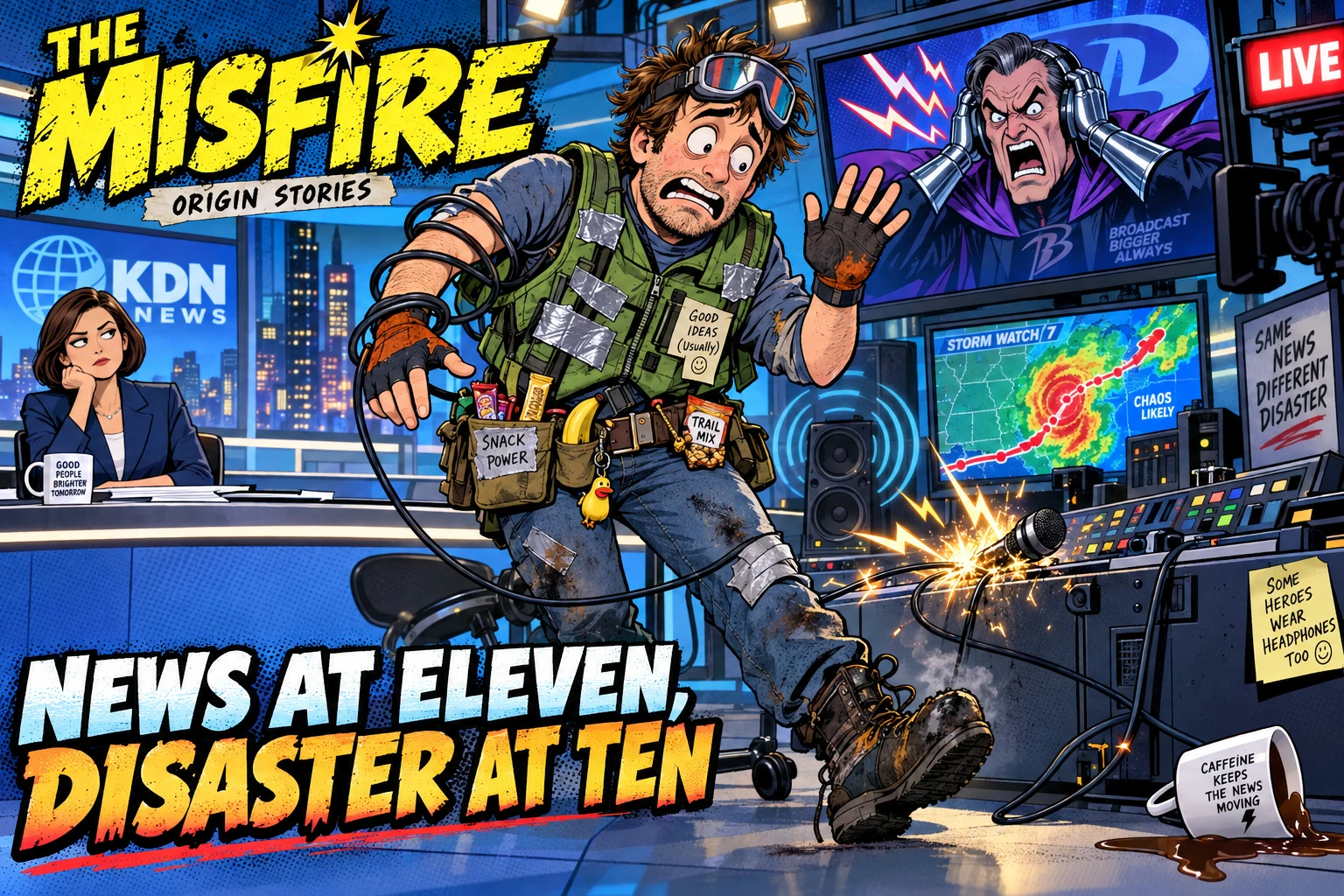
- News at Eleven, Disaster at Ten: A Funny Superhero Television Interview
Max Mercer’s first funny superhero television interview began with a producer asking whether his utility belt contained weapons.
“Mostly snacks,” Max said. “One thing that might open garage doors.”
“Does it?”
“Not garages I recognize.”
Three hours earlier, the city’s most accidental hero had stopped a runaway tram by trying to validate his parking. Now Channel 11 wanted an exclusive interview with The Misfire.
Max wanted to go home before anyone checked the parking meter.
His plan fit on one index card: read two prepared sentences, thank the real heroes, and leave.
Across town, a villain adjusted a silver microphone and prepared to take control of every television in the city.
Only one of them had rehearsed.
Two Sentences, One National Incident
Dana Deadpan sat behind the news desk with the calm expression of someone who had reported three sinkholes and her own divorce without changing her tone.
“Relax,” she told Max. “This is a friendly interview.”
“Will there be questions?”
“That is the traditional obstacle.”
Max checked his index card.
I’m grateful everyone is safe. The real heroes are the emergency crews.
Underneath, he had written: DO NOT EXPLAIN THE PARKING.
A makeup artist approached with powder, examined his scorched boots, mismatched gloves, and duct-taped vest, then quietly returned with a lint roller.
Nearby, meteorologist Stormy Weathers guarded a sleek silver box beside the weather console.
“Our prototype voice modulator,” Stormy explained. “It keeps weather alerts clear over interference.”
“Does it work?”
“It made the pollen report sound like a hostage negotiation.”
Before Max could ask whether the pollen had escaped, a floor manager pointed toward his chair.
“Live in five.”
Max sat.
Something beneath him clicked.
Camera Two lunged forward on its motorized pedestal.
“Four.”
He shifted his weight.
Camera One tilted toward the ceiling.
“Three.”
Max reached under his leg and found a remote with more buttons than his last apartment had electrical outlets.
“Two.”
He tried to put it down.
The camera zoomed directly into Dana’s left nostril.
“One.”
Dana looked into the remaining usable lens.
“Good evening. Tonight, an unusually close look at local journalism.”
Max waved.
The remote clicked again.
Behind them, the giant studio screen displayed a photograph of a casserole.
A Funny Superhero Television Interview Goes Off Script
“Max,” Dana began, “how did you stop that runaway tram?”
Max raised his index card.
“I’m grateful everyone is safe.”
“Of course. But witnesses say you launched a parking kiosk through a bakery window.”
“The real heroes are the emergency crews.”
“Were they operating the kiosk?”
Max turned the card over.
It offered no support.
Meanwhile, beneath an overpass, the Broadcaster stood inside a black communications truck surrounded by monitors. His velvet cape hung from padded shoulders, and a chrome headset curved around his carefully moisturized jaw.
On a secure video call, Precision studied the station schematics.
“The emergency transmitter is yours,” she said. “Begin the subliminal signal at ten exactly. Keep it beneath the normal audio.”
“Soon, every mind in this city will obey my voice.”
“Your instructions are to open the municipal vault and erase the security logs.”
“And subscribe to my premium channel.”
“No.”
“An audience must be cultivated.”
“An arrest must be avoided.”
On his largest monitor, Max stood up too early.
Precision leaned forward.
“Why is Mercer there?”
The Broadcaster glanced at the screen. “Human-interest segment.”
“Abort.”
“It’s a man holding a piece of cardboard.”
“Yes,” Precision said. “That is how these things begin.”
Back in the studio, Max spotted what appeared to be an exit beside a large green wall.
Unfortunately, it was the weather set.
On viewers’ screens, his green vest vanished into the map, leaving his head, gloves, and a packet of cheese crackers drifting over the county.
Stormy stepped into frame.
“We’re seeing a confused system moving east.”
“Is this the hallway?” Max whispered.
“Not since renovations.”
Max backed through a cold front and knocked the weather console with his belt.
The regional radar began a full diagnostic sweep.
Stormy watched a new panel open.
“I’ve been asking engineering to enable that for six months.”
“Happy to help,” Max said.
He stepped sideways and accidentally forecast his own head making landfall on Thursday.
The Broadcaster Interrupts This Disaster
At ten o’clock, every studio monitor flickered.
The Broadcaster’s face replaced the weather map.
“Citizens,” he announced, “your regularly scheduled programming has ended.”
Dana touched her earpiece.
“Is this the mayor?”
A low pulse slipped beneath the villain’s voice.
Across the city, viewers stopped reaching for their remotes. In the studio, the floor manager straightened. A camera operator stared ahead. Stormy began smoothing the same corner of his tie.
Max frowned at the monitor.
“Is that our next guest?”
“I am the Broadcaster.”
“Nice to meet you. Sorry I ran through your weather.”
“Silence.”
“Absolutely. I’ve already used both my sentences.”
Inside the truck, Precision’s voice cut through the secure call.
“Mute his microphone.”
“He is apologizing.”
“That is the dangerous phase.”
The Broadcaster ignored her.
“First, you will listen. Then, you will obey.”
Max knew the feeling. His former government supervisor had opened every staff meeting that way.
He unclipped his microphone, hoping someone more qualified could take over.
The cable caught on a snack pouch.
He tugged.
The microphone sprang free, bounced off Stormy’s mug, and dropped directly into an open service slot in the control console.
A sharp pop cracked through the studio speakers.
Everyone flinched.
Stormy stopped adjusting his tie.
“Why am I saluting the humidity?”
Max crouched beside the console.
“I think I dropped journalism in there.”
He tried to brace himself on the desk. Instead, his mismatched glove landed squarely on the silver voice modulator.
A blue light blinked.
LIVE VOICE PROCESSING: ENABLED.
The Broadcaster’s image grew larger.
“Do not touch that equipment.”
Max looked up.
“Sorry. I didn’t mean to interrupt your interruption.”
His apology came out in the deep, rolling voice of a cathedral experiencing stomach trouble.
Sorry Seems to Be the Loudest Word
The studio shook.
Inside the console, Max’s fallen microphone rested against an exposed monitoring speaker. His voice looped through it, fed into the modulator, and returned louder.
“SORRY.”
A second version followed, several octaves higher.
“SORRY.”
Then a third, sounding like a disappointed submarine.
The Broadcaster grabbed his headset.
“What are you doing?”
“Apologizing,” Max said.
“STOP.”
“Sorry!”
The console howled.
Across the city, the villain’s hidden pulse broke apart beneath a rapidly multiplying chorus of remorse. Viewers blinked, shook their heads, and wondered why they suddenly felt guilty about changing channels.
At a municipal security desk, a guard stopped halfway through unlocking the vault controls.
He looked down at his hand.
Then he put his sandwich back where it belonged.
Inside the station, Dana removed her earpiece and laid it carefully on the desk.
“For viewers just joining us,” she said, “a man in gardening gloves appears to have defeated television.”
Precision slapped both palms against her workstation.
“I told you to mute him.”
The Broadcaster stabbed at his controls. His hijacked emergency link was pulling the feedback straight into the truck’s transmission system.
He cut the studio feed.
The signal kept screaming.
On his screen, a helpful notice appeared.
EMERGENCY BROADCAST LOCK ENGAGED.
Below it:
THIS FEATURE PREVENTS UNAUTHORIZED INTERRUPTION.
Precision read the notice.
“You installed a lockout on your own override.”
“For security.”
She closed her eyes.
Max finally managed to reach the microphone cable.
Unfortunately, it had wrapped around the console’s chair wheel.
He pulled.
The chair rolled into his knees.
Max sat down hard.
From the remote still in his back pocket came a small, decisive click.
Every studio camera turned toward him.
Dana glanced at the nearest lens.
“And now, complete coverage.”
Stormy Weathers Predicts Scattered Arrests
At the weather console, Stormy noticed a bright red smear cutting across the diagnostic display.
“That isn’t a storm.”
Max froze.
“Is it my head again?”
“No. It’s interference.”
The station’s experimental radar interference tracker had marked the source of the unauthorized transmission. As the feedback flooded the hijacked link, the red smear narrowed into a location beside the canal.
Stormy overlaid the street map.
“There. Under the Riverside overpass.”
Dana looked toward him.
“Can you confirm?”
Stormy enlarged the traffic-camera feed from the nearby intersection.
A black truck stood beneath the bridge. Its roof bristled with antennas.
The side read:
ORDINARY FLOWERS
Below that, in smaller lettering:
NO BROADCAST EQUIPMENT
Dana studied the image.
“That seems unnecessarily specific.”
She turned back to her camera.
“Police responding to tonight’s emergency may wish to visit the extremely ordinary flower truck beneath the Riverside overpass.”
Inside the mobile headquarters, the Broadcaster heard sirens.
Precision was already gathering her notes.
“Where are you going?” he demanded.
“To revise my contingency plan.”
“What does it say?”
“It used to say ‘If Mercer appears.’”
“And now?”
“‘When Mercer appears.’”
Her screen went black.
The Broadcaster snatched off his headset and lunged for the rear door.
Outside, a police officer ordered him to keep his hands visible.
“I demand a platform!” the villain shouted.
The officer pointed toward the step beneath the truck’s bumper.
“You’ve got one. Come down slowly.”
Back in the studio, Max freed the microphone.
The feedback stopped.
Silence settled over the room.
Then the loose microphone dropped from his glove and landed in Stormy’s coffee.
Stormy watched it sink.
“That was my backup coffee.”
The Hero Who Wanted to Be the Sidekick
By ten seventeen, police had arrested the Broadcaster, the emergency transmitter belonged to the station again, and the city had returned to ignoring local television voluntarily.
Dana faced Max across the news desk.
“You disrupted a subliminal attack and exposed the villain’s location. How did you know the voice modulator would cancel his signal?”
Max looked toward Stormy.
Stormy folded his arms.
Max looked toward the floor manager.
The floor manager held up a handwritten sign.
DO NOT TOUCH ANYTHING.
Finally, Max found his index card beneath a cracker.
“The real heroes are the emergency crews.”
Dana waited.
“And Stormy,” he added. “He found the flower man.”
“For once,” Stormy said, “a forecast led directly to an arrest.”
Dana turned to the camera.
“Tomorrow, we’ll examine whether the city owes its survival to courage, advanced technology, or a man sitting incorrectly.”
Max leaned toward her.
“Did I do okay as the sidekick?”
For the first time all evening, Dana almost smiled.
“You’ll hear from our insurance company.”
Across town, Precision opened a fresh document.
MERCER RESPONSE PROTOCOL
She typed one sentence:
Never allow him near a microphone.
After a moment, she added:
Or furniture.
At the station, the producer hurried onto the set.
“The clip is everywhere. We’d love to have you back for a weekly segment.”
Max stared at her.
He had prepared no sentences for this.
“I should probably check with the real heroes.”
“We’ll call it Totally Part of the Plan.”
Behind him, a camera pivoted, clipped the weather desk, and knocked an entire bowl of promotional stress balls onto the floor.
Max looked down at the remote protruding from his pocket.
“That wasn’t supposed to happen… but I’ll take it!”
Dana watched the stress balls bounce past her shoes.
“Coming up at eleven,” she said, “damage.”
The Misfire — Every plan backfires… into success.
Advertisement • Discover your next read

Every hero has an origin story. So do comics.
Comic Books: A Graphic History
Max can barely follow two prepared sentences. Fortunately, the story of comics comes with pictures.
Explore the history of visual storytelling, from prehistoric cave paintings to superheroes and manga. Discover the changing formats and remarkable people who helped shape the comics we love today.
Explore the Book on Amazon →No mind-control transmitter required.
As an Amazon Associate I earn from qualifying purchases.